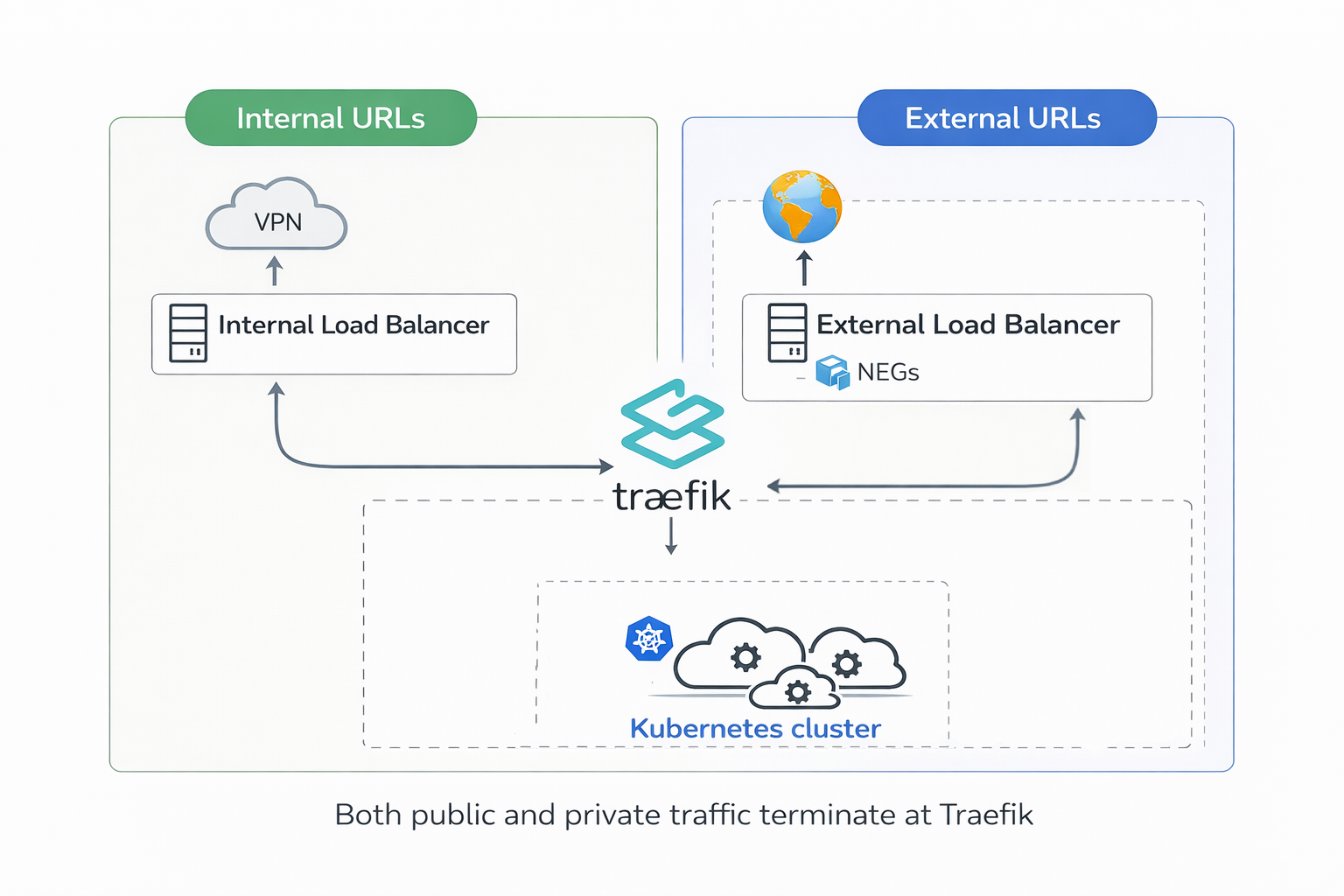
When designing an architecture in GCP with Kubernetes, one of the most important decisions is how to expose internal and external URLs without mixing responsibilities or compromising security.
This is not about “what works”, but about what mental model you want to enforce in your platform.
Internal URLs: accessible only from your network
For internal services (backoffice, operations, private APIs), the cleanest pattern is to use an Internal Load Balancer.
In this model:
- The service has only a private IP
- Access is limited to:
- VPN
- corporate network
- internal workloads within the VPC
- There is no public endpoint reachable from the Internet
In GKE, this is usually implemented as:
- An internal Service or Ingress
- Traefik (or another ingress controller) exposed only through an Internal Load Balancer
- Firewall rules and network routing providing real isolation
The key advantage is clear:
Internal services do not exist for the Internet, not even due to application misconfiguration.
Here, isolation does not rely on headers, paths, or middlewares, but on network boundaries.
External URLs: exposed in a controlled way
For public services (websites, public APIs), the standard pattern is an External HTTP(S) Load Balancer.
A very common and effective design in GKE is:
- External Load Balancer (with Cloud Armor, if applicable)
- The load balancer routes traffic to GKE NEGs
- NEGs point directly to Traefik pods
- Traefik handles routing to services inside the cluster
Important characteristics of this approach:
- Traefik does not need its own public IP
- The only Internet-facing component is the Load Balancer
- Pod access is restricted to Google infrastructure (health checks / proxies)
- No NodePorts or additional Load Balancers are exposed
This pattern reduces complexity and works very well as a public edge, keeping control at the perimeter.
One gateway, two entry paths
Although both patterns use Traefik and Kubernetes, their goals are different:
- Internal: isolation through networking
- External: controlled exposure at the perimeter (LB + WAF)
Both traffic flows converge at the same logical point inside the cluster:
- Internal traffic reaches Traefik through an Internal Load Balancer
- External traffic reaches Traefik through NEGs from an External Load Balancer
The final backend is the same: the cluster’s microservices.
What changes is how traffic reaches them.
The real decision
You can:
- Use Traefik for private URLs
- Use Traefik for public URLs
- Share backend services when it makes sense
But you should never mix entry points.
The decision is not “what works”, but:
what level of isolation you want and where you place your real perimeter.
Designing this separation correctly from the beginning reduces complexity, lowers operational risk, and makes the architecture much easier to reason about over time.
If you are designing or evolving a GKE platform and want to discuss these patterns, you can contact me.
Comments